

In 2026, pressure cleaners are getting wider, faster, and easier to move. Contractors and homeowners alike are seeing 20–30″ surface cleaners, sealed swivels, and improved wheel designs take the lead.
Portable electric models are also becoming more popular for lighter cleaning jobs. These shifts are shaping a market that now focuses on power, efficiency, and easy compatibility.



More Details on Our Top Picks
JANZ 30″ Pressure Washer Surface Cleaner with Wheels
The JANZ 30″ Pressure Washer Surface Cleaner with Wheels is a strong fit provided you need to tackle wide, flat areas fast. You get a 30-inch commercial-grade cleaning path that helps you cover driveways, patios, decks, and sidewalks quickly. Dual high-pressure jets spin to blast away stubborn dirt, and the splash-free skirt keeps overspray down for drier results. Stainless-steel housing, heavy-duty bearings, four castors, and adjustable dual handles add durability and control. It works with most 2,000–4,000 PSI gas or electric washers, and the included nozzles, adapters, and cleaning tool make upkeep easy.
- Surface Size:30-inch
- Max Pressure:2,000–4,000 PSI
- Max Flow:N/A
- Wheels:4 castors
- Material:Stainless steel
- Quick Connect:3/8″ QC
- Additional Feature:Splash-free skirt
- Additional Feature:Adjustable dual handles
- Additional Feature:Replaceable nozzle cores
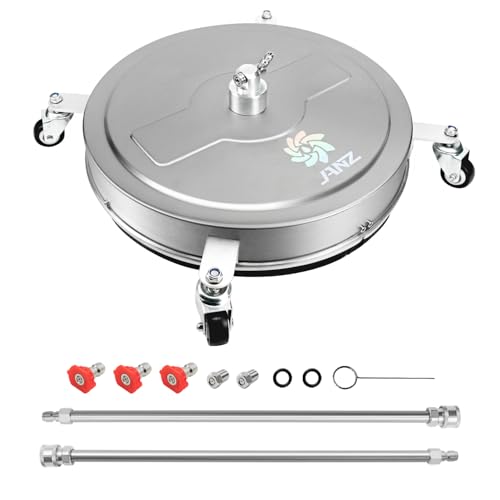
JANZ 20″ Pressure Washer Surface Cleaner 4000 PSI
In the event you need a surface cleaner that can handle bigger jobs without slowing you down, the JANZ 20″ Pressure Washer Surface Cleaner 4000 PSI is a strong fit. You get a stainless-steel body, heavy-duty bearing, and four universal wheels for steady control. Its two spinning jets clean up to eight times faster than a spray nozzle, while the fixed nozzle height helps prevent streaks. It connects with a 1/4″ quick plug to gas or electric washers from 2,000 to 4,000 PSI. You also get an inlet filter, O-rings, nozzle cleaner, and easy-to-remove nozzles.
- Surface Size:20-inch
- Max Pressure:2,000–4,000 PSI
- Max Flow:1.8–3.7 GPM
- Wheels:4 wheels
- Material:Stainless steel
- Quick Connect:1/4″ quick plug
- Additional Feature:Inlet filter included
- Additional Feature:Two extension wands
- Additional Feature:Easy-remove nozzles
14″ Pressure Washer Surface Cleaner with Wheels & Wands
Built for homeowners and pros who need fast, even cleaning on big flat surfaces, this 14″ pressure washer surface cleaner pairs dual high-pressure jets with 4 universal 360° wheels and two 15″ extension wands for smoother control and less fatigue. You can run it from 2000 to 4500 PSI, with 2500 PSI or higher giving the best results. Its 304 stainless steel body, metal jets, heavy-duty bearing, and 180° swivel help it last. Use it on driveways, patios, sidewalks, and decks, then finish details with your pressure washer gun.
- Surface Size:14-inch
- Max Pressure:Up to 4,500 PSI
- Max Flow:1.8–3.7 GPM
- Wheels:4 wheels
- Material:304 stainless steel
- Quick Connect:1/4″ quick plug
- Additional Feature:180° swivel bearing
- Additional Feature:Up to 10-year life
- Additional Feature:Recommended 2500 PSI+
MEKOH Pressure Washer Surface Cleaner (4500 PSI)
MEKOH’s 18-inch pressure washer surface cleaner is a strong pick in case you need fast, streak-free cleaning on driveways, sidewalks, patios, decks, or concrete. You’ll get up to 4500 PSI and 4 GPM, so it tackles dirt, grime, and stains with ease. Its stainless steel body, four-wheel design, and upgraded sealed swivel help you work longer without leaks or clogs. The 3D filter keeps debris out of the nozzles, and the 1/4-inch quick-connect fits many electric or gas washers. You also get useful accessories for setup and maintenance.
- Surface Size:18-inch
- Max Pressure:Up to 4,500 PSI
- Max Flow:4 GPM
- Wheels:4 wheels
- Material:Stainless steel
- Quick Connect:1/4″ quick-connect
- Additional Feature:3D filter system
- Additional Feature:Pre-greased swivel
- Additional Feature:Detergent spray bottle
Janz 20″ Pressure Washer Surface Cleaner with Wheels
The Janz 20″ Pressure Washer Surface Cleaner with Wheels is a strong fit should you want commercial-grade results without slowing down on large flat surfaces. You get a 20-inch path, dual jets, and a fixed nozzle height that helps cut streaks while cleaning up to 8× faster than a lone spray nozzle. Its stainless-steel body, heavy-duty bearing, and splash-free skirt enhance durability and control. You can move it easily on four castors and adjust the dual handle. It works with most 2,000–4,000 PSI gas or electric washers, and the built-in filter helps prevent clogging.
- Surface Size:20-inch
- Max Pressure:Up to 4,000 PSI
- Max Flow:3.7 GPM
- Wheels:4 castors
- Material:Stainless steel
- Quick Connect:3/8″ QC
- Additional Feature:Built-in filter
- Additional Feature:Adjustable dual handle
- Additional Feature:24-hour customer service
FENG PAI 13″ Pressure Washer Surface Cleaner Attachment
FENG PAI’s 13″ Pressure Washer Surface Cleaner Attachment is a smart pick should you want to speed up cleaning on large flat areas without sacrificing control. You can pair it with most gasoline pressure washers through its 1/4″ quick-connect fitting, and its 2 rotating nozzles help you knock out mold, dirt, and stubborn stains fast. The heavy-duty bearing, inlet filter, and durable plastic body support long service life, while the bristle skirt limits splash. Its three wheels and 2 extension wands make driveways, patios, decks, sidewalks, rooftops, and walls easier to clean.
- Surface Size:13-inch
- Max Pressure:N/A
- Max Flow:4.0 GPM
- Wheels:3 wheels
- Material:Durable plastic
- Quick Connect:1/4″ quick-connect
- Additional Feature:Flexible bristle skirt
- Additional Feature:Two threaded wands
- Additional Feature:Max temp 140°F
20″ Pressure Washer Surface Cleaner Attachment (4500 PSI)
Built for demanding driveway, patio, sidewalk, and deck cleaning, this 20-inch pressure washer surface cleaner attachment is a strong fit should you want commercial-grade results without relying on chemicals. You get a 304 stainless steel housing, dual jets, and heavy-duty bearings that spin fast for streak-reducing, up to 10x faster cleaning. It works with 2,000 to 4,500 PSI and 1.8 to 6.6 GPM pressure washers. Four 360° wheels and adjustable handles help you move smoothly, while bristles limit splash and protect edges. Included nozzles, O-rings, tools, and needles make upkeep easier.
- Surface Size:20-inch
- Max Pressure:Up to 4,500 PSI
- Max Flow:1.8–6.6 GPM
- Wheels:4 wheels
- Material:304 stainless steel
- Quick Connect:1/4″ quick-connect
- Additional Feature:Precision connections
- Additional Feature:Adjustable dual handles
- Additional Feature:Chemical-free cleaning
Hiclean Electric Pressure Washer 1800 PSI Portable Cleaning
Hiclean’s Electric Pressure Washer 1800 PSI stands out for buyers who want a compact, portable cleaner that still brings serious punch to everyday outdoor jobs. You get 1800 PSI, 1.2 GPM, and AC power within a 15-pound gray unit with a 20-foot hose and 17-inch wand. The Total Stop System saves energy and helps protect the pump. Use the 15°, turbo, or fan nozzle, plus the foam cannon, for car detailing, patios, decks, stairs, fencing, and furniture. It’s ETL certified, meets PWMA and UL1776, and rides easily via kayak-style handle.
- Surface Size:N/A
- Max Pressure:1,800 PSI
- Max Flow:1.2 GPM
- Wheels:N/A
- Material:N/A
- Quick Connect:Quick-connect nozzles
- Additional Feature:Total Stop System
- Additional Feature:Detachable foam cannon
- Additional Feature:Kayak-style handle
Factors to Consider When Choosing Pressure Cleaners Market Trends
Whenever you compare pressure cleaners, start with the pressure rating range and make sure it matches the surfaces you clean most often. You’ll also want to check surface coverage, wheel and handle design, and the nozzle and jet system for easier control and mobility. Don’t forget compatibility and attachments, since the right extras can make your cleaner far more versatile.
Pressure Rating Range
Pressure rating, measured in PSI, is one of the most significant factors to match to your cleaning task. You’ll want about 1,000–2,000 PSI for cars, outdoor furniture, and other gentle surfaces. For most home driveways, decks, and similar jobs, 2,000–3,000 PSI usually gives you solid results without unnecessary force. Whenever you face oil-stained concrete, heavy grease, or industrial grime, look for 3,000 PSI and above. Don’t chase the highest number; extra pressure can damage surfaces and increase injury risk. Instead, choose the lowest effective PSI and pair it with the right nozzle and technique. Also check GPM, since PSI and flow together determine cleaning power. Finally, make sure hoses, nozzles, and accessories are rated for the washer’s pressure.
Surface Size Coverage
After you’ve matched PSI to the job, the next thing to weigh is how much surface the cleaner can cover per pass. Pick a width that fits your work: 12–16 inches for tight areas, or 12–30+ inches for broad driveways and patios. A wider cleaner lets you finish more square footage with each sweep, so you’ll cut passes and save time on flat surfaces. Make sure your GPM and PSI can support that larger diameter; otherwise, you might lose cleaning power at the edges. For irregular spots, a smaller unit or handheld nozzle helps you avoid missed patches. Estimate area per minute before you buy, because productivity gains can be dramatic. Also, consider whether you can store and transport the larger tool easily.
Wheel And Handle Design
Wheel design can make or break how easy a pressure cleaner is to move and control. You’ll want to match wheel count to your terrain: four 360° casters or universal wheels glide smoothly and stay stable on flat floors, while three-wheel or single-wheel setups help you turn more easily on rougher ground. Look for durable materials like stainless-steel-mounted castors, polyurethane, or rubber, since they resist wear, chemicals, and heat. A sealed, heavy-duty swivel bearing cuts wobble and helps the assembly last under high PSI loads. For handling, choose adjustable dual handles with ergonomic grips, multiple height settings, and rigid mounting. That setup reduces fatigue, improves balance, and makes pushing or pulling heavier cleaners easier.
Nozzle And Jet System
Dial in the nozzle and jet system, and you’ll change how fast and how well a pressure cleaner works. You should weigh nozzle count and jet style initially: a single spray suits simple jobs, but dual or rotary jets can clear flat surfaces several times faster. Next, match orifice size and spray angle to the task. Use a 0°–15° tip whenever you need tight, aggressive force, and choose 25°–40° for broader coverage with less impact. Don’t ignore flow rate; your nozzle has to fit the washer’s GPM, or you’ll lose power or strain the pump. Durable metal cores, removable jets, and inlet filters help you avoid clogs and keep maintenance easy. Standardized threads and quick-connects make switching nozzle types fast and reliable.
Compatibility And Attachments
Once you’ve chosen the right nozzle and jet pattern, the next step is making sure every attachment works cleanly with the pressure cleaner. You should match the cleaner’s PSI and GPM to the accessory’s rating; many surface cleaners need 2,000–4,500 PSI and about 1.8–4.0 GPM. Check quick-connect sizes too, whether you’re using 1/4″ QC, 3/8″ QC, or M22 fittings, so your gun, wand, and extensions don’t leak. Add inlet filtration whenever debris is possible, especially without chemical pre-filtration. Choose dual-jet or single-jet attachments with the right swivel bearings and nozzle height for streak-free coverage. Finally, verify adapters, O-rings, and thread seal materials before you begin, since missing seals and mismatched threads can quickly reduce performance.
Frequently Asked Questions
How Will Automation Affect Pressure Cleaner Demand in 2026?
Automation will increase demand for pressure cleaners in 2026 as smarter systems reduce labor and shorten job times. You will likely choose efficient, connected units that provide consistent results with less manual effort.
Which Eco-Friendly Features Matter Most to Buyers in 2026?
You’ll care most about water saving modes, biodegradable detergents, lower energy use, and recyclable parts. You’ll also value quieter operation and durable designs because they cut waste, reduce costs, and make cleaning feel more responsible overall.
How Are Smart Controls Changing Pressure Cleaner Purchases?
Smart controls are leading buyers toward pressure cleaners with app-based scheduling, pressure presets, and usage alerts; 68% of buyers now prefer connected features. These tools help you save time, cut waste, and select models that match your routine.
What Retail Channels Will Dominate Pressure Cleaner Sales in 2026?
Online marketplaces and direct to consumer brand sites will lead pressure cleaner sales in 2026, while big box retailers remain strong for shoppers who prefer in store purchasing. Specialty dealers and home improvement chains will continue to attract premium buyers who want service support and expert guidance.
Will Cordless Models Gain Market Share in 2026?
Yes, cordless models will probably take more market share in 2026 because they are easier to carry and store. They will not replace corded units, but you will use them more often for fast, light outdoor cleaning jobs.
