

Ceiling fans in 2026 are doing more than moving air. The best models now blend quiet DC motors, smart controls, dimmable lighting, and designs that fit everything from modern farmhouse rooms to low ceilings and outdoor spaces. The ZMISHIBO, Depuley, Roomratv, and LEDIARY options each serve a different need, but the real question is which one offers the best balance of style, comfort, and value.


More Details on Our Top Picks
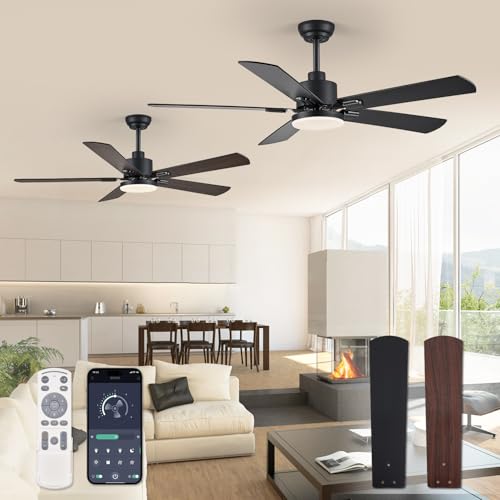
ZMISHIBO 2-Pack 52″ Ceiling Fan with Lights
If you want a modern ceiling fan set that can cool medium-sized rooms efficiently while keeping noise low, the ZMISHIBO 2-pack 52″ ceiling fan with lights is a strong fit. You get a black farmhouse look with reversible walnut and black blades, plus a matte black motor that suits bedrooms, dining rooms, offices, kitchens, and living rooms. The DC motor delivers strong airflow at just 35 decibels and can cut power use by 20% to 30%. You can adjust six speeds, timer settings, brightness, and three color temperatures with the remote or app.
- Size:52 inch
- Light:LED light
- Control:Remote/app
- Motor Type:DC motor
- Blade Count:5 blades
- Reversible:Yes
- Additional Feature:2-pack value bundle
- Additional Feature:Dual-finish blades
- Additional Feature:Wall-switch compatible
Depuley 52 Inch Outdoor Ceiling Fan Without Light
The Depuley 52 Inch Outdoor Ceiling Fan Without Light is a strong pick if you want a sleek, modern fan that moves a lot of air without adding extra glare. You get a quiet brushless DC motor, six speeds, reversible operation, and a remote plus app control for easy tweaking. Its 3-blade ABS design fits indoor or outdoor spaces, from your patio to your bedroom, while the white, brushed finish keeps things clean and contemporary. It runs at just 30 decibels, saves energy with standby shutoff, and installs on a ceiling mount with durable, family-safe construction.
- Size:52 inch
- Light:No light
- Control:Remote/app
- Motor Type:Brushless DC
- Blade Count:3 blades
- Reversible:Yes
- Additional Feature:Outdoor-rated design
- Additional Feature:ABS blade construction
- Additional Feature:Standby shutoff feature
Depuley 52-Inch Ceiling Fan with Light Remote Control
With its 52-inch three-blade design, quiet DC motor, and dimmable LED light, the Depuley Ceiling Fan suits anyone who wants strong airflow without the noise. You can install it in your living room, bedroom, patio, porch, garage, gazebo, or even a home office. The remote lets you adjust fan speed and brightness from your seat, and the wide coverage keeps your space comfortable year-round. It’s family-friendly, works well around pets and elders, and includes built-in protection that shuts the motor off if the blades stop, helping prevent overheating and damage.
- Size:52 inch
- Light:LED light
- Control:Remote
- Motor Type:DC motor
- Blade Count:3 blades
- Reversible:Yes
- Additional Feature:Built-in motor protection
- Additional Feature:No-load auto stop
- Additional Feature:Family-friendly safety design
Roomratv Ceiling Fan with Lights and Remote Control
Roomratv’s 52-inch ceiling fan suits you best when you want strong air circulation, simple light control, and quiet everyday performance in one fixture. You get an LED light with three color temperatures, and you can switch them with the remote. The memory function brings back your last setting, so you won’t keep adjusting it. Its quiet DC motor improves efficiency, and low-speed operation helps save energy and reduce wear. You also get six speeds, three timers, reversible airflow for summer and winter, and durable ABS blades that stay stable and wobble less.
- Size:52 inch
- Light:LED light
- Control:Remote
- Motor Type:DC motor
- Blade Count:3 blades
- Reversible:Yes
- Additional Feature:Memory function lighting
- Additional Feature:Integrated blade structure
- Additional Feature:Reduced wobbling design
Roomratv 52-Inch Ceiling Fan with Lights and Remote
If you want a smart, quiet ceiling fan that lets you fine-tune both airflow and lighting, the Roomratv 52-Inch Ceiling Fan with Lights and Remote is a strong pick. You can use the remote, mobile app, or Wi-Fi to set six speeds, control the fan and light separately, and program 2-, 4-, or 8-hour timers. Its reversible DC motor pushes up to 5,259 CFM at just 35 dB, so you get strong summer cooling and winter circulation. The 15-watt LED dims from 10% to 100% and offers 3000K, 4500K, or 6000K tones.
- Size:52 inch
- Light:LED light
- Control:Remote/app
- Motor Type:Reversible DC
- Blade Count:3 blades
- Reversible:Yes
- Additional Feature:Wi-Fi enabled
- Additional Feature:Fan-light independent control
- Additional Feature:Wall-mount remote bracket
Roomratv Ceiling Fan with Lights and Remote Control
The Roomratv ceiling fan with lights and remote control is a strong pick for anyone who wants easy comfort and efficient performance in one fixture. You get a 52-inch fan with an LED light, three color temperatures, and a memory function that brings back your last setting. The quiet DC motor helps cut noise, energy use, and wear, while six speeds and 1-, 4-, or 8-hour timers keep control simple. Its reversible motor supports summer cooling and winter circulation. The integrated 52-inch ABS blades improve stability, reduce wobble, and help you enjoy smooth, reliable airflow year-round.
- Size:52 inch
- Light:LED light
- Control:Remote
- Motor Type:DC motor
- Blade Count:52 inch ABS blades
- Reversible:Yes
- Additional Feature:Memory function lighting
- Additional Feature:Integrated blade structure
- Additional Feature:Reduced wobbling design
LEDIARY Flush Mount Ceiling Fan with Lights and Remote
LEDIARY’s 20-inch flush mount ceiling fan suits you best if you want a low-profile fan that packs lighting, airflow, and smart control into one compact design. You can adjust the LED light from 3000K warm to 6000K white, dim it from 10% to 100%, and enjoy 2800 lumens with memory function. Its seven-blade, brushless DC motor delivers strong, quiet airflow at six speeds, with reversible settings for summer or winter. You can control the fan and light separately by remote or app, use the timer, and install it easily indoors in bedrooms, kitchens, or offices.
- Size:20 inch
- Light:LED light
- Control:Remote/app
- Motor Type:Brushless DC
- Blade Count:7 blades
- Reversible:Yes
- Additional Feature:Flush mount profile
- Additional Feature:360° signal reception
- Additional Feature:Beeping sound canceled
Factors to Consider When Choosing Ceiling Fans
Choosing a ceiling fan begins with matching it to the room size, since coverage affects comfort and efficiency. Blade count, motor type, airflow, speed options, and noise level also play important roles in overall performance. A careful comparison of these factors helps narrow the best choice for each space.
Room Size Match
Room size should guide fan selection, with blade diameter matched to the area so airflow stays effective without causing excess turbulence; a 52-inch fan, for example, is generally suited to medium rooms around 12 ft. x 12 ft. to 18 ft. x 18 ft. Smaller rooms usually need a more compact fan, while larger spaces benefit from wider diameters that spread air evenly. Ceiling height also matters: downrod-mounted models are often preferable for standard or tall ceilings, whereas flush mounts suit low-profile rooms. In rooms with sloped ceilings, the rated incline should be checked before purchase, since some models handle only modest angles. Airflow capacity should also align with room size, because a stronger output can help cover expansive areas more effectively.
Blade Count Matters
Blade count can influence both how a ceiling fan feels and how it sounds, with common designs ranging from 3 blades for a streamlined, faster-moving look to 5 or 7 blades for a fuller, often smoother spread of air. Fewer blades usually place less load on the motor, which can support efficiency, while more blades add visual coverage and alter airflow direction. A 3-blade model often favors stronger circulation and a clean profile. A 5-blade fan tends to offer a familiar middle ground between performance and appearance. More blades may slightly soften the direct breeze, yet they can improve perceived smoothness and stability. Blade count should be weighed with motor power, blade pitch, and fan size, since those factors combine to shape overall airflow.
Motor Type Choice
Motor type is one of the most important factors in a ceiling fan’s performance and daily comfort. A DC motor is often the best choice for efficiency, since it can cut power use by about 20% to 30% while still offering multiple speed settings. Brushless DC models are frequently quieter than traditional motors, with some operating around 30 to 35 decibels, which suits bedrooms and offices. For long-term reliability, a pure copper motor stands out because it supports high-speed operation and improves durability over time. Reversible motors add seasonal flexibility by changing airflow direction for summer cooling and winter circulation. When comparing options, it is also wise to examine speed levels and control precision, because many modern DC fans offer six speeds and timer functions for convenient operation.
Airflow And Speed
Airflow and speed should be evaluated together, since a ceiling fan works best when it can move air effectively without creating unnecessary noise. Multiple speed settings, such as six options, allow the user to adjust circulation for changing weather, sleep, or daily comfort. Fan size also matters; a 52-inch model is usually appropriate for rooms about 12 by 12 feet to 18 by 18 feet, where balanced coverage is needed. Efficient airflow depends on the motor as well, and a DC or brushless DC design can deliver strong circulation while using less energy than a standard motor. Reversible airflow adds flexibility, pushing air downward in summer and upward in winter. The best choice combines force, control, and room-matched performance for dependable year-round use.
Noise Level Check
Noise level should be checked in decibels, since quieter ceiling fans are often the best fit for bedrooms, offices, and other calm spaces. Models rated around 30–35 dB are typically considered low-noise choices. A brushless or DC motor often operates more quietly than older motor types and can improve efficiency at the same time. Blade balance also matters: well-balanced blades and a secure mount help limit wobbling, which can keep sound levels down over years of use. Noise expectations should be compared across all speed settings, because low speeds are usually far quieter than high speeds. If the fan offers reversible operation, its sound profile should remain calm in both directions, especially when year-round comfort is the goal.
Lighting Options
Lighting options should be evaluated by output, color range, and control flexibility, since the best ceiling fan lights do more than simply switch on. A practical fan light often uses 15W to 24W LEDs and produces about 2,400 to 2,800 lumens, enough for useful room illumination. Multiple color temperatures are valuable, with three settings from warm 3000K to cool 6000K helping suit relaxing evenings, focused work, or general tasks. Dimmable operation adds further value, especially when brightness can move smoothly from 10% to 100%. A memory function also helps by restoring the previous brightness and color after power is restored. Finally, lighting should be easy to access through remote, app, or wall-switch support, making everyday adjustments straightforward.
Control Features
Control features can make a ceiling fan far easier to use day to day, especially when convenience and precision matter. Remote control support lets a user adjust speed, light, and direction from across the room, reducing the need to reach a wall switch. App control adds another layer of convenience, allowing settings to be managed from a phone and often pairing with timers and separate fan and light controls. Multiple speed settings, such as six-speed control, offer finer airflow adjustment than basic low, medium, and high options. Timer functions, including 1-hour, 4-hour, or 8-hour shutoff, can save energy and simplify overnight use. A memory function is also valuable, since it restores the last brightness or color setting after power is turned off, preserving preferred comfort.
Installation Compatibility
Installation compatibility can determine whether a ceiling fan fits a space safely and performs as intended. The first check is mount type: some fans support flush mounting, while others require a downrod, and the wrong choice can prevent installation altogether. Ceiling angle also matters, since certain models suit flat ceilings only, while others accommodate an incline below 15°. Room size should match fan diameter; a 52-inch fan generally suits spaces about 12 x 12 feet to 18 x 18 feet. Ceiling height and included hardware, such as 4-inch or 8-inch downrods, affect blade clearance and safety. Electrical requirements and control options should also align with the space, including voltage, wall-switch wiring, remote use, or app control.
Frequently Asked Questions
How Do I Know if My Ceiling Box Can Support a Fan?
He looks for a ceiling box marked fan rated or stamped acceptable for fan support. If that marking is missing, he should treat it as unsuitable for a fan and have it inspected.
Can a Ceiling Fan Help Lower My Energy Bills?
Yes, a ceiling fan can help cut energy bills. It moves air across the room so you can set the thermostat about 4°F higher, which can reduce cooling costs by 10% to 15% when the room is occupied.
What Blade Material Is Best for Humid Rooms?
For humid rooms, ABS plastic blades or coated metal blades are usually the best choice because they resist moisture, warping, and rust. A well sealed composite blade can also work reliably in spaces with consistently high humidity.
How Often Should I Clean and Maintain Ceiling Fan Blades?
Ceiling fan blades should be dusted once a month and cleaned more thoroughly every three to six months. In humid, dusty, or heavily used rooms, cleaning may be needed more often to prevent buildup and keep the fan balanced.
Are Smart Ceiling Fans Worth the Extra Cost?
Like a ceiling fan with a control panel on your phone, a smart ceiling fan can improve comfort through app control, scheduling, and better energy use. It is worth the extra cost if you want easier operation, lower power use, and automation rather than just moving air.
